
Justice Gap Solutions Scoping Work Group
Summary:
The Justice Gap Solutions Scoping Work Group is a four-month initiative convened jointly by the Washington State Bar Association (WSBA) Board of Governors and the Access to Justice Board.
The Justice Gap Solutions Scoping Work Group is a four-month initiative convened jointly by the Washington State Bar Association (WSBA) Board of Governors and the Access to Justice Board. Its purpose is to review existing data, research, and innovative approaches in Washington and nationwide in order to identify and recommend high-impact, equity-centered solutions that can help close the justice gap. These recommendations will be presented to the WSBA Board of Governors and Access to Justice Board in the fall to inform them of their next steps for pursuing innovation in Washington within their respective spheres of influence.
The work group's directive includes:
Read the most recent update on the work group's efforts. | 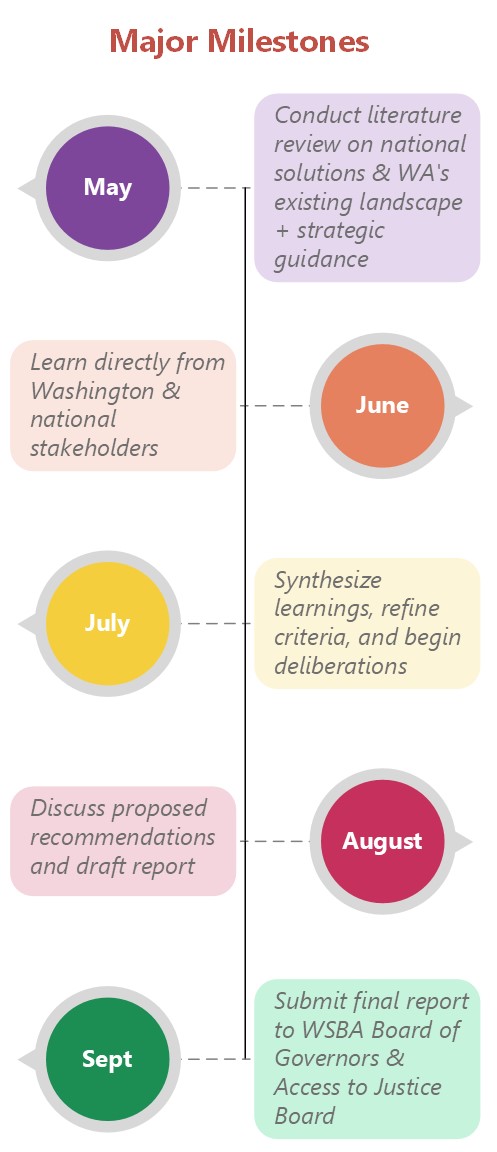 |
Work Group Members
Members include representatives from civil legal aid, lived-experience community members, state agencies, criminal defense, and other legal practitioners.
Co-chairs:
Carla Sullivan, Access to Justice Board member
Jordan Couch, WSBA Board of Governors at-large member
Contact
Staff Liaison: Bonnie Sterken, Equity and Justice Manager
Frequently Asked Questions
What is the “justice gap”?
The justice gap refers to the difference between the legal needs people experience and the resources available to help meet those needs. Washington and national data show that low-income and historically marginalized communities are disproportionately impacted.
What is the work group tasked with doing — and not doing?
The work group is tasked with reviewing existing data, research, and innovative approaches related to closing the justice gap, both in Washington and nationally. Its purpose is to identify and recommend which high-impact, equity-centered solutions the WSBA Board of Governors and the Access to Justice Board should prioritize next and determine what groups should be involved in crafting those solutions.
The work group will not design new programs, change court rules, create licensing structures, or implement system-wide reforms.
This is a four-month scoping phase, not a full policy reform process.
What will the work group produce?
A scoping phase report summarizing research findings, key themes, and recommendations for which solutions the WSBA Board of Governors and the Access to Justice Board should explore further. The structure of this work group is intentionally time-bound and deliverable-based.
Why now and why the Board of Governors and Access to Justice Board?
Ongoing gaps in access to legal assistance, combined with national innovation in service delivery models, present an opportunity for Washington to refine and prioritize its strategy. Many groups in Washington are already discussing and exploring various solutions. The Board of Governors and Access to Justice Board have launched this work group to thoughtfully inform how they should engage and advance these discussions. The final product will inform their strategic priorities going forward and directly shape what they choose to advance next.
Will the work group design new programs or rules?
No. The group’s scope is recommendations only, not solution design or rulemaking.
How is the work group ensuring that it centers communities most impacted by the justice gap?
The planning for the work group stresses use of an equity lens that centers communities disproportionately affected by unmet legal needs. In practical terms, that includes:
- Inviting community members who have lived experience expertise and have faced significant barriers to accessing justice, such as those stemming from race, poverty, or other systemic inequities, to join as voting members.
- Making space for literature and data that explain not just solutions, but the problem from community perspectives. Embedding an equity lens into the deliberations and expectations of the work group’s activities.
Will materials be public?
Yes. Periodic updates, meeting summaries, and final materials will be posted here.
What happens after the work group finishes its four-month charge?
At the end of the scoping phase, the work group will deliver its report to the WSBA Board of Governors and the Access to Justice Board. Those entities will then determine:
- Which solutions to explore further.
- What resources and further study may be needed.
- Which policy or program pathways are viable within their authority.